


Article by Caleb McIntyre, TRAK Pilot, Vancouver Island, BC
Cover image by Braden Gunem.
END (noun)
an objective: the ultimate result, aim, or purpose of an action.
Let's face it. Most people in the world today have no idea what a real sea kayak is capable of.
I often reflect on how I used to perceive kayaking as a young person who grew up on the west coast of Canada. I admit it: I was one of those kids who used to think 'kayaking is for old people.' From the outside looking in, sea kayaking seemed slow and honestly kind of boring... especially when compared with adrenaline-laden sports like mountain biking or surfing.
That's until I experienced by first multi-day sea kayak expedition on the exposed west coast of Vancouver Island. I was only 23 at the time. Those surf landings, rock gardens, raging storms, and remote beaches humbled me as a young man. The reality of true sea kayaking changed the way I perceived the sport, and ultimately led me to become a sea kayak guide throughout the rest of my 20s and early 30s.

Above: Caleb (the author) is dwarfed amongst volcanoes and white caps during a 20km crossing from Isla de Ometepe to the mainland of Nicaragua in December 2025. Photo by James Appleton | Rat Race Adventures.
Kayaking has taken me around the world and back. But when I look around, the sport doesn't seem to be growing. In fact, I think it might be at risk of dying...
Okay, maybe I'm being a bit dramatic here. But when I compare the recent growth of other expeditionary 'sports' like bike packing, thru-hiking, and climbing, I'm often left wondering "what about sea kayaking?"
And I know I'm not alone... TRAK's brick n' mortar paddlesports partners are struggling to maintain their sales volumes from previous years - especially amongst true touring, expedition sea kayaks.
So what's changed?
 Above: Braden Gunem prepares a meal over a campfire while exploring the Alaskan coast with his partner, Claire. Braden and Claire are one of those amazing (and rare) power couples that travel the world together, exploring with their TRAKs.
When TRAK produced its first performance folding sea kayak over 20 years ago, sea kayaking was still in the global spotlight. Feature films and documentaries were being made about the sport, and baby boomers around the world were investing in high-end fibreglass boats to take them further, carry more gear, and thrive in more complex conditions. This was the early 2000's, when sea kayaking was arguably at its peak.  Above: a media clipping from CanoeKayak.com in August 2007 featuring the T-1600, TRAK's first publicly available model.
This all changed years later with the widespread introduction of cheap inflatables, origami 'kayaks,' and paddle boards - most of them made by companies with no history in water sports. With most of these new models having more in common with toys than real watercraft, increasingly portable products gradually saturated the mainstream market with low-cost, low-quality options that altered what outdoor enthusiasts came to expect from 'kayaking' in general.

Above: so-called 'kayaks' available at a Walmart for as little as $195 USD; made by LifeTime, a company that also produces playgrounds, plastic chairs, and storage sheds.
The effect?
Over time, customers and their outfitters have stopped appreciating real sea kayaks for their hull shape, efficiency, cargo capacity, rescue potential, or seaworthiness. Instead, they've been influenced to focus on finding the lowest price, prioritizing stability over efficiency, and maximizing compactness for easy storage and transport; factors that are ultimately at odds with what real sea kayaking become famous for in previous decades.
In turn, the concept of kayaking has transformed from an expedition-based risk activity to a primarily recreational one; from multi-day tours in remote areas to hour-long 'lily dips' with the dog and a beer (hopefully with a PFD on!); from a specialized niche sport to an 'entry-level' activity that supposedly requires no skill or safety training.

Above: TRAK Pilots from around the world gather to celebrate the release of the TRAK 2.0 back in 2018. Even before the pandemic drove exponential demand for entry-level paddle sports, the pendulum towards 'recreational' kayaking was already in full swing.
While this process has certainly made paddle sports more accessible to broader audiences and income levels, it also serves to minimize and trivialize the very real risks involved in paddle sports. This, in turn, exposes more and more novices to new risks they were not prepared or trained for, resulting in a surge of drowning related deaths in recent decades - especially involving packable, low-cost watercraft.

Above: a news report from North Vancouver in November 2024, involving a missing kayaker who was paddling a "white collapsable kayak" (likely an Oru) without a lifejacket or immersion gear. This person is still missing and presumed dead.
On the business front, longstanding sea kayak manufacturers have largely failed to counter the gradual 'enshittification' of the paddle sports industry, naively assuming that their strong reputations and the short-lived legacy of 'real' sea kayaking would be enough to weather this storm of cheap knock-offs.
But this (lack of a) strategy has failed. Lacking enough new customers to sustain their core business, many high-end sea kayak manufacturers have been forced to close shop or file for bankruptcy, further eroding the community that has grown around true expedition sea kayaking since the 1990s. This includes legendary hardshell brands like Seaward, Boreal Designs, Hobie, Riot, and Necky, as well as premium packable kayak companies like Feathercraft. Many other small kayak brands have been bought up and amalgamated with their mass-produced competitors.

Meanwhile, new off-shore manufacturers have pivoted accordingly, producing wider, shorter plastic 'kayaks.' These boats float, but otherwise have nothing in common with the original skin-on-frame qajaqs that were developed and perfected by Arctic Indigenous peoples thousands of years ago.
Instead of seeking seaworthy tools - vehicles for exploration, hunting, trade, and survival in the some of the roughest ocean conditions on Earth - we are seeing the continued proliferation of cheap plastic junk that provides no lasting value or fulfillment beyond the initial rush of an impulse purchase.
I believe that TRAK stands in the face of this movement that threatens to relegate sea kayaking from a risk-oriented water sport to a dull, pedestrian activity.
As a paddler first and a TRAK employee second, I can only hope that sea kayaking brands can play a stronger, more active role in protecting and preserving what remains of the heart and soul of true sea kayaking.
Part of this involves reminding the world why sea kayaking became a sport in the first place, as well as directly addressing common barriers to sea kayak ownership - especially when it comes to storage, transport, and training.
 Above: Claire finds her way ashore amidst a sketchy landing. Photo by Braden Gunem.
At the same time, I believe we must protect this sport from obsolescence by making sea kayaking more possible and accessible - not by cutting corners or minimizing quality to lower costs, but by engineering real sea kayaks that fit the lifestyles of modern paddlers today: compact AND performance-oriented, without compromises in safety, efficiency, or payload.
All of us at TRAK believe that sea kayaking is a form of seamanship that demands respect, training, and humility. We take pride in our vessels, the research and engineering behind them, and purpose for which they are built: for real paddlers; for real sea kayaking; for real rescues; real rolling; real expeditions; real travel.
While I'm worried about the future of sea kayaking, I also get a spark of hope whenever we sell a kayak to someone under 50, under 40, or even under 30. It's rare, but it's happening more and more.
The water is calling us back.

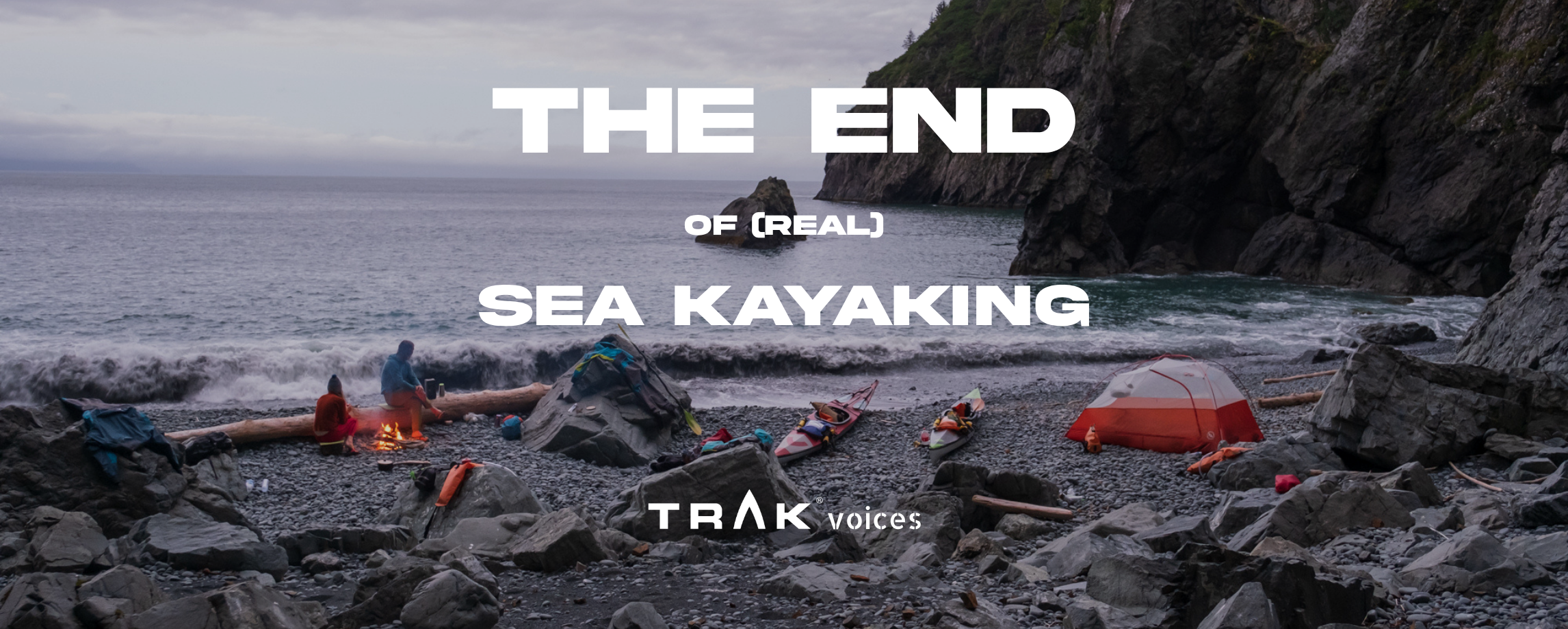
Above: Image by Braden Gunem taken on the Alaskan coast.
If portability is just as important to you as safety and performance, trust your instincts. Leave the knock-offs behind and get TRAK'n.
About the Author: Caleb is a seasoned wilderness guide and outdoor educator with an professional background in marketing and business development. When he's not leading TRAK's growth, he can be found exploring his backyard on two wheels or with paddle in hand, often with his family in tow. You can reach Caleb directly at caleb@trakkayaks.com.





Aktie: